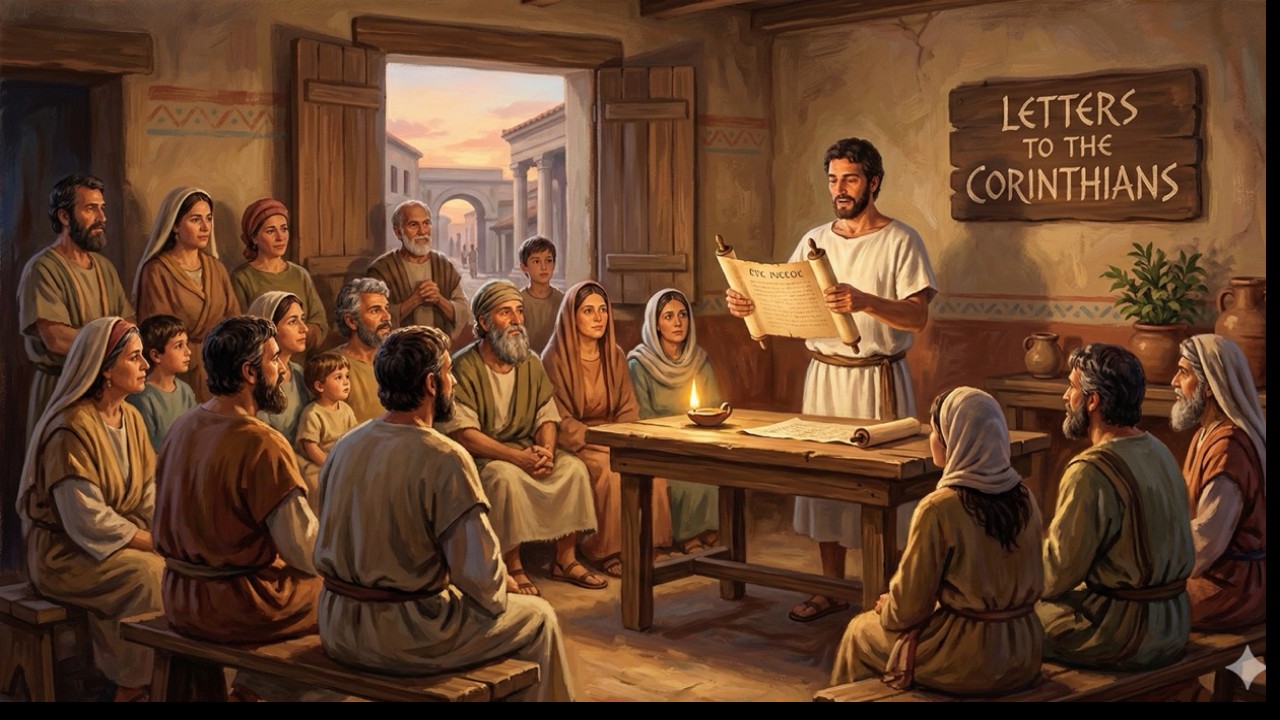
Take your Bibles with me and turn to...Take your Bibles with me tonight and turn to 1 Corithians 11. We looked at the first part of this last week and talked about head coverings, tonight we are going to look at the second part which deals with the Lord's Supper.
Let's go ahead and read the whole second half of the chapter, starting in verse 17
[!bible] 1 Corinthians 11:17-34 - KJV17. Now in this that I declare unto you I praise you not, that ye come together not for the better, but for the worse. 18. For first of all, when ye come together in the church, I hear that there be divisions among you; and I partly believe it. 19. For there must be also heresies among you, that they which are approved may be made manifest among you. 20. When ye come together therefore into one place, this is not to eat the Lord’s supper. 21. For in eating every one taketh before other his own supper: and one is hungry, and another is drunken. 22. What? have ye not houses to eat and to drink in? or despise ye the church of God, and shame them that have not? What shall I say to you? shall I praise you in this? I praise you not. 23. For I have received of the Lord that which also I delivered unto you, That the Lord Jesus the same night in which he was betrayed took bread: 24. And when he had given thanks, he brake it, and said, Take, eat: this is my body, which is broken for you: this do in remembrance of me. 25. After the same manner also he took the cup, when he had supped, saying, This cup is the new testament in my blood: this do ye, as oft as ye drink it, in remembrance of me. 26. For as often as ye eat this bread, and drink this cup, ye do shew the Lord’s death till he come. 27. Wherefore whosoever shall eat this bread, and drink this cup of the Lord, unworthily, shall be guilty of the body and blood of the Lord. 28. But let a man examine himself, and so let him eat of that bread, and drink of that cup. 29. For he that eateth and drinketh unworthily, eateth and drinketh damnation to himself, not discerning the Lord’s body. 30. For this cause many are weak and sickly among you, and many sleep. 31. For if we would judge ourselves, we should not be judged. 32. But when we are judged, we are chastened of the Lord, that we should not be condemned with the world. 33. Wherefore, my brethren, when ye come together to eat, tarry one for another. 34. And if any man hunger, let him eat at home; that ye come not together unto condemnation. And the rest will I set in order when I come.
At our church, we take the Lord's Supper once a month, almost always on Sunday Afternoon after a fellowship meal.
Believe it or not, there is a biblical precedent for that. In the early church, they got together and they had a fellowship meal, which they called "the love feast" and then they took the Lord's supper.
The "love feast" wasn't anything special. It was just a potluck supper. In fact, there is a story of how some Romans took some early church christian girls captive and tortured them to get information about what the Christian church actually did in their meetings, and one of the things that came out of that was "they eat a lot."
Way back in Acts 2 it tells is that they continued "in breaking of bread" and "ate their meat from house to house." The early church ate together then they took the Lord's Supper together.
But there was a problem in this Corinthian church, they were misbehaving so badly during their potluck supper, that they basically were making the Lord's Supper that followed it completely meaningless.
In fact, Paul says something shocking here in verse 17. He basically says "I have nothing good to say about you in this matter. When you gather together, you're doing more harm than good. In fact, what you're doing isn't even the Lord's Supper anymore."
Then Paul goes on to set them straight about the Lord's supper. So I want to talk about this tonight in three points:
- The problem with how the Corinthians were taking the Lord's Supper.
- The prescription of the Lord's supper.
- The practice of the Lord's supper.
I hope to show you through these three points that the Lord's Supper isn't just about remembering what Christ did—it's about recognizing who we are together as his body.
Let's pray and we'll jump into that.
The first thing we are going to look at tonight is...
- The problems with the Lord's Supper ======================================
Or more accurately, the problems with how the Corinthians were taking the Lord's supper.
The biggest problem that they had in the church was the problem of division. Paul dealt with this in chapter one. Remember, he heard from Chloe's house that there were divisions.
Those divisions extended to how they thought about leadership, how they thought about law suits, how they thought about idol meat, how they thought about gender roles and now - how they conducted the Lord's supper.
But it's interesting as you look at this - these weren't theological divisions - they were sociological divisions. In other words, they weren't fighting over who believed what, they were breaking apart based on class. When it came to the Lord's supper, it was rich verses poor.
A large percentage of the people in this church were likely slaves. They had nothing. They didn't even have the day off - they could only come to the church when their work was over for the day.
It is very likely that they were looking forward to this meal as their one good meal in the whole week. But by the time they got there, the rich people had eaten everything leaving just scraps for them.
The rich people turned it into a banquet. They brought their own food and made sure they ate it all and gave nothing to share. They were even getting drunk - while these poor people had nothing to eat.
That was the central problem going on here. As one commentary writer, Andrew Wilson, put it:
This was supposed to be a common meal, a potluck supper where everyone shared equally, but the rich turned it into an airplane meal - where first class gets to eat first and everyone else gets the leftovers.
And this was worse than hunger. Verse 22 says and shame them that have not? They weren't just not giving these poor people food, they were embarrassing them and reminding them of their lower state.
This made Paul very angry. This made a sham of the whole thing.
I'll never forget a missions trip we had in Mexico one time. We worked alongside these wonderful people in the church. Dug foundation ditches and mixed concrete by hand in a pit in the ground for a week.
At the end of the week, one of the families who were just precious people, a father, a mother and four children went to Burger King. (Yes, they have Burger King in Mexico.) We were just pigging out, eating American food for the first time in a week. But do you know what that family told us - it was the first time they had ever been to a restaurant.
Church, we have so much. God has blessed us. But not everyone has money to throw around. Not everyone even has all of the food they need. We need to be super careful that we don't ever do anything to make the precious people in our church who might not have as much feel less than.
So do you see what was happening? The Lord's supper is supposed to bring us together. Chapter 10 verse 16 calls it "the communion of the blood of Christ and the communion of the body of Christ" But they were using it to divide, not bring them together. This is why Paul said this isn't even the Lord's Supper you are doing.
So then, what is the Lord's supper? Let's move on to our second point:
- The prescription for the Lord's Supper =========================================
Look at verses 23-26 again. These verses should be VERY familiar to you. You've probably heard them dozens and dozens of times because I read them every time we take the Lord's supper.
[!bible] 1 Corinthians 11:23-26 - KJV23. For I have received of the Lord that which also I delivered unto you, That the Lord Jesus the same night in which he was betrayed took bread: 24. And when he had given thanks, he brake it, and said, Take, eat: this is my body, which is broken for you: this do in remembrance of me. 25. After the same manner also he took the cup, when he had supped, saying, This cup is the new testament in my blood: this do ye, as oft as ye drink it, in remembrance of me. 26. For as often as ye eat this bread, and drink this cup, ye do shew the Lord’s death till he come.
There are several things I want to point out to you in these verses:
First, notice that this is something that was received from the Lord. Paul didn't make this up. This practice came right from Jesus - who instituted this practice during His last night of freedom.
Jesus did it during a passover observance - part of the passover meal is that they would eat unleavened bread and drink several cups of wine.
Unleavened bread, bread without yeast, is brittle. It's like a cracker - which is why we usually just eat broken up crackers. (For awhile we used actual passover bread, but crackers are much easier to get and taste better.)
At the end of this meal Jesus broke up this bread and passed it out and said "take, eat this is my body which is broken for you, this do in remembrance of me." Then, after they had finished eating he did the same thing with the cup "this cup is the new testament in my blood, this do ye, as oft as ye drink it, in remembrance of me."
Now, what does all of that mean? This has been a point of contention among Christians for a very long time.
I remember when I worked in politics in High School, one of my friends and coworkers was a staunch catholic, and he always wanted to argue about this passage.
You see, the Catholics believe in transubstantiation. They basically believe that Jesus death is an ongoing sacrifice and that when the priest blesses the bread and wine, they actually become the body and blood of Jesus (without changing form) and have saving power.
Martin Luther taught consubsantiation. He didn't believe anything happened to the bread and wine, but that Jesus presence was "in, with and under" the Lord's supper elements.
Calvin taught something called spiritual presence - that the bread and wine are just bread and wine, but when we take the Lord's Supper Jesus comes with us in a real and spiritual way.
Zwingli taught that it was just a memorial and nothing more.
Most Baptists, and I would include myself here, believe it's a memorial—but not just a memorial. There's something real and spiritual that happens when God's people gather at his table to remember Christ together.
There is also the matter of what it is called:
- Most high churches call it The Eucharist.
- Some call it "communion."
- Some call it "The Lord's Table" or "the Lord's Supper"
- and some just call it "breaking bread."
Do you know what is interesting? Every one of those terms is in 1 Corithians 10 and 11. Paul used all of these names. (Eucharist is the greek word translated "given thanks" in verse 23.) All of these names describe different aspects of the Lord's Supper - so maybe we should use all of them.
But here's what Paul wants the Corinthians to understand: Whatever view you take of what happens to the bread and wine, one thing is absolutely clear—when we eat this bread and drink this cup together, we are proclaiming something. Verse 26: 'as often as ye eat this bread, and drink this cup, ye do shew the Lord's death till he come.' We're declaring to each other, to the watching world, and to God himself that Jesus died for us—and that his death has made us one body. This isn't a private devotional moment. It's a corporate declaration.
That leads me to my last point tonight...
- The purpose of the Lord's supper ===================================
In several of the commentaries I read, they use a helpful outline to talk about what we should be doing as we take the Lord's supper: We should be looking back, looking forward, looking within and looking around.
Let's walk through these...
When we take the Lord's supper we should be looking back at what Christ did.
Jesus said "this do in remembrance of me." We've already talked about this.
When we take the Lord's supper, it is an object lesson, a tangible reminder of how and why Jesus died. He died for us, He died to establish a new covenant, and His body was broken for us, crushed for us. His blood was shed for us.
When we take the Lord's supper, we should be remembering that. Looking back.
When we take the Lord's supper we should be looking forward to when Christ comes back.
Jesus said "ye do show the Lord's death till he come." The Lord's supper isn't a funeral meal, it is a meal of anticipation. It is us saying "we know Jesus is coming back, and someday we will eat this meal with Him, we will banquet together with Him." It looks forward to the wedding supper of the Lamb, where we will eat with Jesus after His return.
So looking back, looking forward.
When we take the Lord's supper we should be looking within to examine ourselves.
Look at verse 27 again:
[!bible] 1 Corinthians 11:27 - KJV27. Wherefore whosoever shall eat this bread, and drink this cup of the Lord, unworthily, shall be guilty of the body and blood of the Lord.
I want to tell you what I think this means and what I don't think it means:
Remember, these Corinthians were using the Lord's Supper (or what they called the Lord's supper) to shame and starve their poorer brothers and sisters in Christ. So much so that it wasn't even the Lord's Supper they were doing.
I think this is the kind of thing Paul has in mind when he says "if you take it unworthily, you are guilty of the body and blood of the Lord."
This is very important: in one sense, all of us are unworthy. None of us are perfect. All of us come short of the glory of God. There is no more important time for us to remember that we are unworthy and it is only by God's grace than when we are taking the Lord's Supper and thinking about what He did for us.
The Lord's supper isn't supposed to be a celebration feast - "yeah, woohoo, I'm holy enough to take the supper!" - it's supposed to be a time of receiving what Christ has done for us.
So when it says "unworthy" hear, I believe it is about how you take it, not about being worthy enough.
But if we make a mockery of this, then there are consequences - and Paul says for this cause many are sickly among you and many sleep.
This isn't a new idea in the New Testament. Four times in Acts God killed people because of the way they were acting. Hebrews tells us that who the Lord loves He chastens.
It is very possible for God to bring you sickness and even take you home to save you from making a mockery of the Supper. This is serious business. So we should examine ourselves as we take it.
We look back, we look forward, we look within, finally...
When we take the Lord's supper we should be looking around to include others.
Look at verses 33-34. This is Paul's conclusion here:
[!bible] 1 Corinthians 11:33-34 - KJV33. Wherefore, my brethren, when ye come together to eat, tarry one for another. 34. And if any man hunger, let him eat at home; that ye come not together unto condemnation. And the rest will I set in order when I come.
Paul brings it back to the love feast. He says when you eat together, wait. Make sure these poor people have what they need. If you are super hungry, take care of that at home.
But notice what he's really saying: Wait for one another. Look around. See each other. Remember that you are one body.
This is verse 29 again—not discerning the Lord's body. The Corinthians weren't recognizing that the poor slave sitting across from them was part of the same body they claimed to be remembering. They were treating the Lord's Supper like it was all about them and Jesus—a private transaction between themselves and God.
But it's not. When we take the Lord's Supper, we're making a public declaration that we are one body. That the person sitting next to you—whether they're rich or poor, whether you like them or not, whether they look like you or not—that person is your brother or sister in Christ. You share the same Savior, the same cross, the same hope.
And if we're one body, then how we treat each other matters. Not just at the communion table, but everywhere.
Let me bring this home practically. We don't have the exact same situation as Corinth—we don't have a love feast where some people are gorging themselves while others go hungry. But we can still violate this principle.
Every time we gossip about a brother or sister, we're failing to discern the body.
Every time we show favoritism to the wealthy or successful and ignore the poor or struggling, we're failing to discern the body.
Every time we let bitterness or unforgiveness create division in the church, we're failing to discern the body.
Every time we take communion while harboring hatred or contempt for another believer, we're eating and drinking unworthily.
Paul's command to the Corinthians is simple: Wait for one another. Make sure everyone is included. Make sure no one is left out or shamed or forgotten.
Church, when we gather at this table, we're saying something powerful: Jesus died to make us one. His broken body has healed the divisions between us. His shed blood has purchased people from every tribe and tongue and nation and made us into one family.
So when you take the Lord's Supper, look around. See your brothers and sisters. Remember that you're not alone at this table—you're surrounded by the body of Christ. And let that truth shape how you treat each other, not just during communion, but every single day.
CONCLUSION
Let me close with this: The Lord's Supper isn't just about remembering what Christ did for you personally. It's about recognizing who we are together as his body.
When we take this bread and cup, we're declaring that Christ has made us one—one body, one family, one people. And if that's true, then how we treat each other isn't a side issue. It's central to what this meal means.
The Corinthians got this wrong. They used the Lord's Supper to display their divisions instead of their unity. They shamed the poor. They elevated themselves. And Paul said, "What you're doing isn't even the Lord's Supper anymore."
Don't let that be true of us. When we come to this table, let's come with hearts that are looking back at the cross, looking forward to Christ's return, looking within to examine ourselves, and looking around to see and honor the body of Christ.
Let's pray.