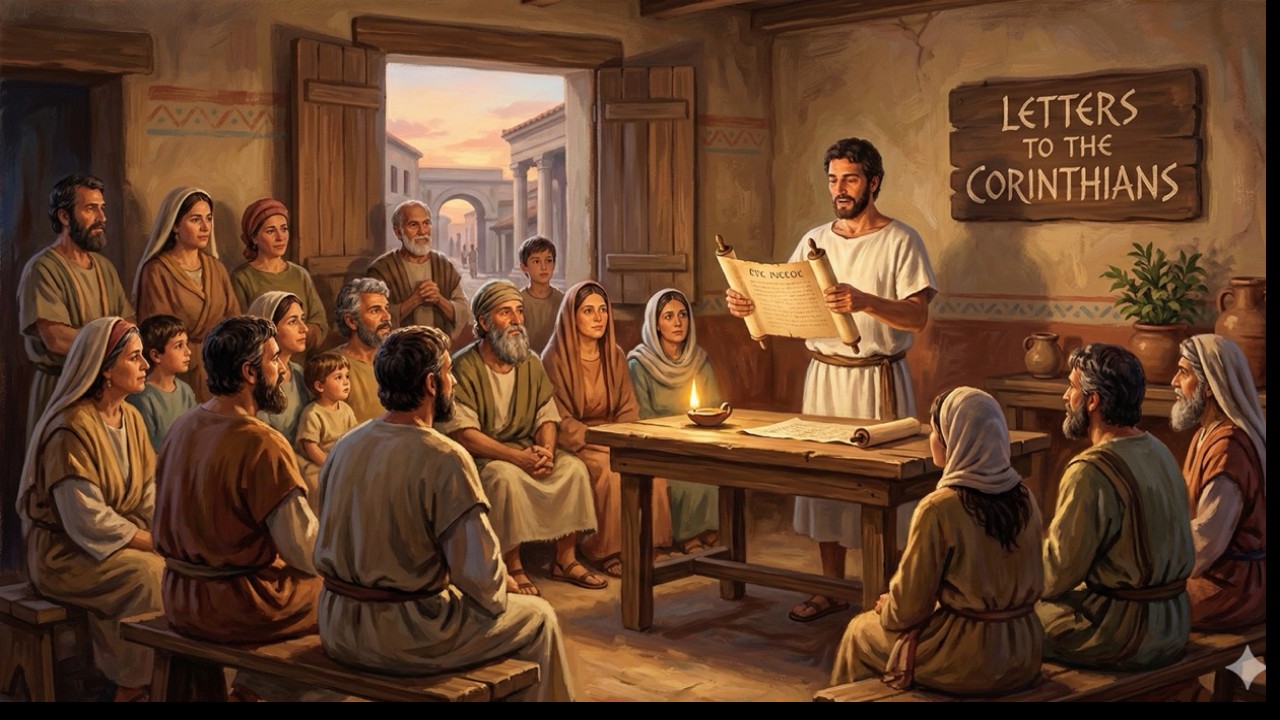
Take your Bibles with me and turn to 1 Corinthians 9. I Corinthians 9.
Last week we looked at this whole chapter, and I explained that the whole chapter is Paul illustrating chapter 8. The message of chapter 8 is that we have liberty in Christ, but that we need to sometimes set that liberty aside for the sake of others and for the sake of the gospel.
In chapter 9 it is like Paul saying "look at me, here is how I live out this principle and how I set aside my liberty and rights for the sake of others." The biggest right Paul had that he set aside was the right to get paid.
So Paul does something very interesting here: he gives an impassioned and biblical plea for why pastors should get paid, then he explains why he chooses not to get paid despite that for the sake of the gospel. So he's basically saying "do you want to talk about rights? I have a clear right to get paid, but I'm choosing not to out of my love for you and for the sake of the gospel."
Now, I told you this last week, but I purposely skipped over most of it because i wanted to focus on the bigger picture - on how we should set aside rights and liberty and live above that. But I want to go back today and look at Paul's argument for why pastors should get paid specifically.
Let's read our text. 1 Corinthians 9:6-18
[!bible] 1 Corinthians 9:6-18 - KJV6. Or I only and Barnabas, have not we power to forbear working? 7. Who goeth a warfare any time at his own charges? who planteth a vineyard, and eateth not of the fruit thereof? or who feedeth a flock, and eateth not of the milk of the flock? 8. Say I these things as a man? or saith not the law the same also? 9. For it is written in the law of Moses, Thou shalt not muzzle the mouth of the ox that treadeth out the corn. Doth God take care for oxen? 10. Or saith he it altogether for our sakes? For our sakes, no doubt, this is written: that he that ploweth should plow in hope; and that he that thresheth in hope should be partaker of his hope. 11. If we have sown unto you spiritual things, is it a great thing if we shall reap your carnal things? 12. If others be partakers of this power over you, are not we rather? Nevertheless we have not used this power; but suffer all things, lest we should hinder the gospel of Christ. 13. Do ye not know that they which minister about holy things live of the things of the temple? and they which wait at the altar are partakers with the altar? 14. Even so hath the Lord ordained that they which preach the gospel should live of the gospel. 15. But I have used none of these things: neither have I written these things, that it should be so done unto me: for it were better for me to die, than that any man should make my glorying void. 16. For though I preach the gospel, I have nothing to glory of: for necessity is laid upon me; yea, woe is unto me, if I preach not the gospel! 17. For if I do this thing willingly, I have a reward: but if against my will, a dispensation of the gospel is committed unto me. 18. What is my reward then? Verily that, when I preach the gospel, I may make the gospel of Christ without charge, that I abuse not my power in the gospel.
I've met many people over the years who try to argue something like this: Pastors make too much money or Pastors shouldn't get paid.
I've literally had this discussion with dozens of people. And I don't think the Bible is unclear about this at all. If you believe the Bible is our sole authority for faith and practice then this isn't up for debate.
There are multiple chapters in the New Testament that very clearly teach that pastors should be paid and paid well. This is probably the longest logical and biblical argument for that in the whole Bible.
Paul is saying here that paying pastors is practical, biblical, and spiritual. Then he explains why in his particular case, he chooses not to get paid.
So let's break that down into four points.
- Paying pastors is practical. ===============================
Look again at verse 7:
[!bible] 1 Corinthians 9:7 - KJV7. Who goeth a warfare any time at his own charges? who planteth a vineyard, and eateth not of the fruit thereof? or who feedeth a flock, and eateth not of the milk of the flock?
Paul is asking some obvious rhetorical questions here:
Question 1: do soldiers go to war without getting paid?
No, that's ridiculous. Soldiers not only get equipped for what they are doing by someone else, but they get paid for it. While they are fighting, their meals, their lodging, their clothing - all of it is someone else's concern.
Question 2: who plants a vinyard, and doesn't get to eat the fruit?
Obvious answer - nobody. If you are a farmer, of course you are going to eat your own produce. Even if you are working on someone else's farm, you are going to get some of that for yourself.
Question 3: who feeds a flock and doesn't get to drink the milk of that flock?
Again, same obvious answer. Nobody. If you are a dairy farmer, of course you get to drink the milk.
So what is Paul saying here: he's saying that in every other aspect of life we understand that if you spend your life working on something, you should be rewarded for it and taken care of by that work - why is it any different for pastors?
It's perfectly natural for pastors to get paid. Imagine saying to someone: listen, we want you to go to college and spend years preparing for some work, then we want you to move away from your family and give your whole life to that work. We want you to devote your whole self to it - and by the way, you won't get paid. This is all volunteer.
There is no other area of life where that makes the slightest bit of sense and it doesn't make sense in the ministry either.
So it's natural for pastors to get paid.
Let's look at Paul's second point here...
- Paying pastors is biblical. ==============================
Look at verses 8-10:
[!bible] 1 Corinthians 9:8-10 - KJV8. Say I these things as a man? or saith not the law the same also? 9. For it is written in the law of Moses, Thou shalt not muzzle the mouth of the ox that treadeth out the corn. Doth God take care for oxen? 10. Or saith he it altogether for our sakes? For our sakes, no doubt, this is written: that he that ploweth should plow in hope; and that he that thresheth in hope should be partaker of his hope.
Paul is saying this isn't just natural, it's also biblical. This isn't just his idea, it's God's idea. He goes back to the Old Testament law, specifically to Deuteronomy 25:4 which says:
[!bible] Deuteronomy 25:4 - KJV4. Thou shalt not muzzle the ox when he treadeth out the corn.
And Paul says "God didn't put that in there for oxen. He put that in there as a principle for us."
So what is the principle: It is wrong to expect people to work in an area and not receive some kind of temporal reward.
Not only is it wrong, it also is counterproductive. Do you want reluctant pastors or excited pastors? Do you want pastors who feel like it is a life sentence or pastors who are excited to do the work?
Well, if you remove all hope of remuneration from the equation, than you end of up hopeless, reluctant pastors.
Paul goes on in verse 13 to make another Biblical argument. Look at that:
[!bible] 1 Corinthians 9:13 - KJV13. Do ye not know that they which minister about holy things live of the things of the temple? and they which wait at the altar are partakers with the altar?
He's saying look at the priests in the Old Testament. Not only were they taken care of by the government, they also ate directly from the shewbread and offerings. If God designed it so clearly that the priests were cared for, why wouldn't he do the same for ministers of the gospel?
So in this chapter, Paul makes it very clear that paying ministers isn't just a practical and natural matter, but a biblical matter.
Now, what about outside of this chapter? The Bible talks about this in other places.
[!bible] 1 Timothy 5:17-18 - KJV17. Let the elders that rule well be counted worthy of double honour, especially they who labour in the word and doctrine. 18. For the scripture saith, Thou shalt not muzzle the ox that treadeth out the corn. And, The labourer is worthy of his reward.
Or what about when Jesus sent out his disciples, He said:
[!bible] Matthew 10:10 - KJV10. Nor scrip for your journey, neither two coats, neither shoes, nor yet staves: for the workman is worthy of his meat.
This is a clear biblical principle.
So it's natural to pay pastors, it's biblical to pay pastors. Paul adds a third point:
- Paying pastors is spiritual. ===============================
Look at verse 11:
[!bible] 1 Corinthians 9:11 - KJV11. If we have sown unto you spiritual things, is it a great thing if we shall reap your carnal things?
Some form of this idea shows up several times in the New Testament. The idea is that if we really value spiritual things, then we should freely share our material things with those God is using to teach us spiritual things.
For instance
[!bible] Galatians 6:6 - KJV6. Let him that is taught in the word communicate unto him that teacheth in all good things.
[!bible] Romans 15:27 - KJV27. It hath pleased them verily; and their debtors they are. For if the Gentiles have been made partakers of their spiritual things, their duty is also to minister unto them in carnal things.
There is this clear idea in the scripture that teaching people the word is a great thing and if we truly value it, than we should be willing to pay those who give their lives to do it well.
Before I move off of this, let me just get practical with you. It is true that there are some preachers who are lazy. It is also true that there are some preachers who basically live like kings at the expense of their flock. But those men are the exception, not the rule.
Name another job where a person is expected to be a leader, to live in a way that is above reproach, where he is expected to receive costly training that usually comes with college debt - and make so little money.
If you look at any other profession:
- business
- education
- public service (police, firemen)
- military service
And you compare it to what the average pastor is paid, who do you think is better taken care of?
Now, the reason for that usually is just the inability of the church to pay more. Because they don't have the people or they have other pressures and debts. That is fine. It is a calling, not a mercenary endeavor.
But if that is the case because someone thinks that pastors should be poor - I challenge you to find that in the Bible. You won't.
The Bible as a whole and this passage in particular are crystal clear that the laborer is worthy of his hire and that pastors should be paid.
So that is why the last point Paul made is so powerful. Write down number 4:
- Paul chose not to get paid for practical and personal reasons. =================================================================
Look at verses 15-18 again:
[!bible] 1 Corinthians 9:15-18 - KJV15. But I have used none of these things: neither have I written these things, that it should be so done unto me: for it were better for me to die, than that any man should make my glorying void. 16. For though I preach the gospel, I have nothing to glory of: for necessity is laid upon me; yea, woe is unto me, if I preach not the gospel! 17. For if I do this thing willingly, I have a reward: but if against my will, a dispensation of the gospel is committed unto me. 18. What is my reward then? Verily that, when I preach the gospel, I may make the gospel of Christ without charge, that I abuse not my power in the gospel.
Let me explain what I think Paul was saying here. I think the apostle Paul had both practical and personal reasons for not being paid by the church.
Clearly he thought that he deserved to be paid and in other places, he did get paid. But in this case, for the Corinthians, he chose to forgo getting paid.
His personal reasons are what he talks about here - and I think the best way to understand them is that Paul felt like he wasn't a volunteer, he was a conscript. Remember, he was out persecuting Christians and when Christ showed up on the road to Demascus, not only did God call Paul to salvation, but God called Paul to this specific service.
So Paul felt like ministry for him was not optional - God would do terrible things to him if he didn't preach the gospel like he was called to do.
And so for Paul, doing it for free, even when he didn't have to, was his was of being a volunteer. It was the one thing he felt he could do to show that he wanted to serve the Lord. It was the one thing he could boast in, and it was very important to him.
That was his personal reason. But he also had practical reasons and that was he felt that preaching the gospel for free - in that particular context where money was so important to people - made him a more effective witness.
It may have been that the Corinthians were so used to being used for commerce, they were used to being squeezed for a dollar, and they were so all about the bottom line - that Paul could really break through to them by serving as their pastor for free.
Think about the big city - I was in one yesterday. Everything is expensive. Everything has a price tag. Imagine how refreshing it was for them to meet someone with no financial motive in serving them - other than to see them saved and discipled.
So let's wrap this up...
Paul voluntarily laid down his "right" to get paid so that he could show love to these Corinthians and so that the gospel would advance.
And that is the bigger principle here - we ought to be willing to lay down our rights, our liberties for the sake of others and the sake the gospel.
I doubt very seriously that you'll ever be asked to make the kind of sacrifices for others that Paul voluntarily made in this chapter. No one is asking you to work two jobs and one for free. They might ask you to not go to a certain restaurant or to stop watching certain movies, and when you think about it - that is nothing if we really care for others.
Let me ask you - if you were a missionary in a muslim country, would you ladies wear a head covering? You would, or you would never win anyone.
If you would do it for others around the world, shouldn't you be willing to do it for the people you share a pew with at home?