author: Ryan Hayden Flip over
Take your Bibles with me and turn to Ezra 1. Ezra chapter 1.
We are going to start a new series tonight, looking at a book I've never preached from. It's really going to be a series through several books, as we are going to take this time to also look at the books that go along with it. So we are going to be talking about Ezra, Nehemiah and Esther, but also probably Haggai and Zechariah.
What we are doing is actually looking at a period in Biblical history that doesn't get talked about much. It's the end of the Old Testament. The period after the exile. I've been studying this a ton, and I feel like I've just dipped my toes in it.
We are going to talk a lot about history tonight. We are going to look at some prophecy tonight. But I hope when we are done to show you a few things:
- First, God keeps His promises.
- Second, God shows mercy to His people, even in judgment.
- Third, God revives His people.
So these big historical things we are talking about - they have very practical and current applications. Hang with me.
Let's go ahead and read Ezra chapter 1 tonight and then we'll get into the message:
[!bible] Ezra 1:1-11 - KJV
- Now in the first year of Cyrus king of Persia, that the word of the LORD by the mouth of Jeremiah might be fulfilled, the LORD stirred up the spirit of Cyrus king of Persia, that he made a proclamation throughout all his kingdom, and put it also in writing, saying,
- Thus saith Cyrus king of Persia, The LORD God of heaven hath given me all the kingdoms of the earth; and he hath charged me to build him an house at Jerusalem, which is in Judah.
- Who is there among you of all his people? his God be with him, and let him go up to Jerusalem, which is in Judah, and build the house of the LORD God of Israel, (he is the God,) which is in Jerusalem.
- And whosoever remaineth in any place where he sojourneth, let the men of his place help him with silver, and with gold, and with goods, and with beasts, beside the freewill offering for the house of God that is in Jerusalem.
- Then rose up the chief of the fathers of Judah and Benjamin, and the priests, and the Levites, with all them whose spirit God had raised, to go up to build the house of the LORD which is in Jerusalem.
- And all they that were about them strengthened their hands with vessels of silver, with gold, with goods, and with beasts, and with precious things, beside all that was willingly offered.
- Also Cyrus the king brought forth the vessels of the house of the LORD, which Nebuchadnezzar had brought forth out of Jerusalem, and had put them in the house of his gods;
- Even those did Cyrus king of Persia bring forth by the hand of Mithredath the treasurer, and numbered them unto Sheshbazzar, the prince of Judah.
- And this is the number of them: thirty chargers of gold, a thousand chargers of silver, nine and twenty knives,
- Thirty basons of gold, silver basons of a second sort four hundred and ten, and other vessels a thousand.
- All the vessels of gold and of silver were five thousand and four hundred. All these did Sheshbazzar bring up with them of the captivity that were brought up from Babylon unto Jerusalem.
Some books in the Old Testament focus on a single family or a single individual that more or less lived their whole life in obscurity.
You could say that about a book like Ruth, which is about a widow from Bethlehem that no one would have ever heard of if it wasn't for the book and for her famous grandson - David.
But you could also say that even about some of the patriarchs. Abraham and Isaac and Jacob lived pretty isolated lives in a small region of Canaan.
Ezra isn't like that at all. Ezra is a book that talks about some of the greatest people and events in history and shows us how God was working through them.
Look at verse 1 again:
[!bible] Ezra 1:1 - KJV
- Now in the first year of Cyrus king of Persia, that the word of the LORD by the mouth of Jeremiah might be fulfilled, the LORD stirred up the spirit of Cyrus king of Persia, that he made a proclamation throughout all his kingdom, and put it also in writing, saying,
There are at least four historical things that this verse alludes to that we need to understand if we are going to make sense of this book.
"Cyrus king of Persia"
The first is Cyrus. This is Cyrus the great. He was the head of the Medi-Persian (or Archaemenid) empire and one of the greatest conquering kings who ever lived.
Persia is in modern day Iran. It was a really small little kingdom that was surrounded by the Medes. Who were more powerful.
Cyrus grandfather (his mother's father) was the king in charge of the Median empire. A man named Astyages.
After Cyrus became king of Persia (which was ruled by the Median Empire) he went to war against the Medes and against his grandfather - and Cyrus was able to convince the general and many of the people of his grandfather's army to defect and fight with him.
Here is something that Cyrus seemed to do really well. He would find the way that a rival king had mistreated people and he would exploit that to get the people he was conquering on his side. He knew that religion was very special to people and he would exploit that to get allies as he conquered people.
So Cyrus took over the Medes and formed the Medi-Persian empire, or the Archaemenid empire and then started conquering other lands.
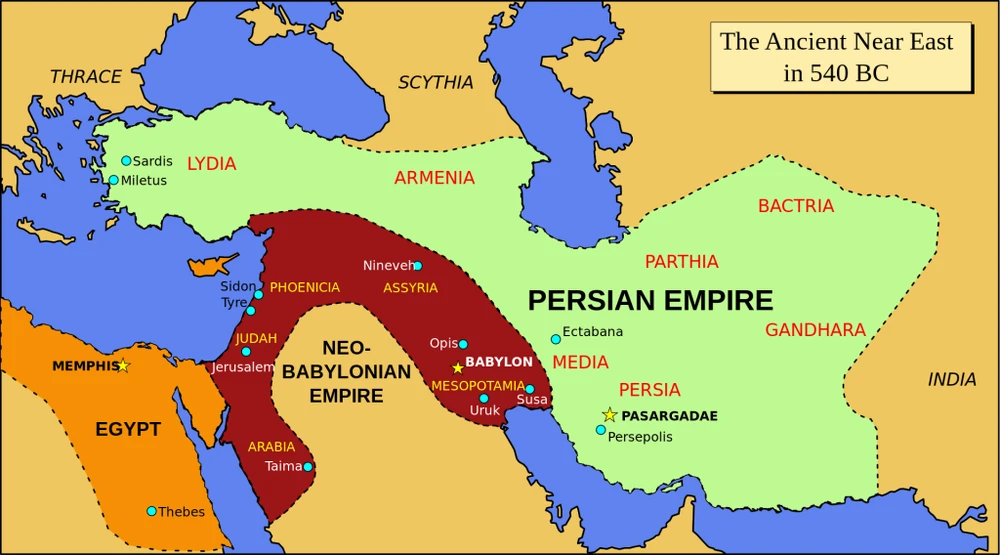
The first land they conquered was the Lydian empire - which was what we would today call Turkey and in those days was called Asia minor.
Actually, Lydia attacked first and brought Cyrus into war. Cyrus tried to get people in the Lydian army to defect and failed. He defeated the Lydian in battle by using camels instead of horses, which confused the cavalry of the Lydians.
The next nation Cyrus conquered was the Babylonian empire. Cyrus defeated Babylon mostly by getting lots of people to defect.
But the king of Babylon and the city of Babylon itself were pretty safe and thought to be impenetrable. They had these giant walls and they thought they could live under seige forever. Cyrus famously defeated the city of Babylon by digging to reroute the Euphrates river and they just walked into the city on the river bed.
The first year of Cyrus
And so back in our text where it says in the first year of Cyrus king of Persia it's talking about the first year after Cyrus took over the Babylonian empire.
At this point Cyrus is basically in charge of the known world. I mean the Persian's eventually took over much of India, they ruled Egypt, they ruled everybody.
So when Cyrus and the Persians took over Babylon, they also took over the jews. Remember, Babylon had taken the jews captive and deported them to Babylon.
And right away, in Cyrus' first year in control, he sends the jews back home.
Look at verse 1 one more time...
[!bible] Ezra 1:1 - KJV
- Now in the first year of Cyrus king of Persia, that the word of the LORD by the mouth of Jeremiah might be fulfilled, the LORD stirred up the spirit of Cyrus king of Persia, that he made a proclamation throughout all his kingdom, and put it also in writing, saying,
The word of the LORD by the mouth of Jeremiah
So there is one more key thing in this verse I want to talk about before I move on, and that is the part that says "that the word of the LORD by the mouth of Jeremiah might be fulfilled."
Turn with me to Jeremiah chapter 29. Look at verse 1:
[!bible] Jeremiah 29:1 - KJV
- Now these are the words of the letter that Jeremiah the prophet sent from Jerusalem unto the residue of the elders which were carried away captives, and to the priests, and to the prophets, and to all the people whom Nebuchadnezzar had carried away captive from Jerusalem to Babylon;
So Jeremiah was writing to the captives in Babylon. The same group of people that Cyrus the great inherited when he took over Babylon. There were false prophets among the people who were saying "We are going home soon." And Jeremiah had to correct that.
Look at verse 4:
[!bible] Jeremiah 29:4 - KJV4. Thus saith the LORD of hosts, the God of Israel, unto all that are carried away captives, whom I have caused to be carried away from Jerusalem unto Babylon;
Jeremiah is saying "God wants you to know, He is behind this. This is His doing."
Keep reading:
[!bible] Jeremiah 29:5-7 - KJV5. Build ye houses, and dwell in them; and plant gardens, and eat the fruit of them; 6. Take ye wives, and beget sons and daughters; and take wives for your sons, and give your daughters to husbands, that they may bear sons and daughters; that ye may be increased there, and not diminished. 7. And seek the peace of the city whither I have caused you to be carried away captives, and pray unto the LORD for it: for in the peace thereof shall ye have peace.
What's Jeremiah saying? He's saying "get comfortable. Settle in. God's wants you to make the most of your time there in Babylon."
These prophets who are telling you it's going to be over are lying to you. That is not God's plan.
Look at verse 9:
[!bible] Jeremiah 29:9 - KJV9. For they prophesy falsely unto you in my name: I have not sent them, saith the LORD.
Now, look at verses 10-11:
[!bible] Jeremiah 29:10-11 - KJV10. For thus saith the LORD, That after seventy years be accomplished at Babylon I will visit you, and perform my good word toward you, in causing you to return to this place. 11. For I know the thoughts that I think toward you, saith the LORD, thoughts of peace, and not of evil, to give you an expected end.
God said you are going to be there 70 years. 70 years.
Now, I'm forty-one. I'm not very good at math. How old will I be 70 years from now?
Oh.
Molly is 14. Actually, 14 today. Molly, how old will you be 70 years from now?
Oh.
So, here is the thing: they weren't going home. They were to make the best of the situation they found themselves in, but they weren't going home.
Now, in Ezra, those 70 years are passed, and Cyrus takes over Babylon, and one of the first things he does is say: Jews, you can go home now.
And it perfectly fulfills that prophecy from Jeremiah.
But that's not the only prophecy that is fulfilled. Turn with me to Isaiah 44.
Now, Jeremiah was active about 70 years before Cyrus burst on the scene, but Isaiah was active two hundred years before Cyrus.
Look at what Isaiah 44:28 says:
[!bible] Isaiah 44:28 - KJV28. That saith of Cyrus, He is my shepherd, and shall perform all my pleasure: even saying to Jerusalem, Thou shalt be built; and to the temple, Thy foundation shall be laid.
Listen, 200 years before Cyrus was around Isaiah wrote a prophecy and said a man named Cyrus would come and cause Jerusalem to be rebuilt and the temple to be rebuilt.
And look here at Ezra 1. Look at verse 3:
[!bible] Ezra 1:3 - KJV3. Who is there among you of all his people? his God be with him, and let him go up to Jerusalem, which is in Judah, and build the house of the LORD God of Israel, (he is the God,) which is in Jerusalem.
Cyrus, this pagan king, causes the people to return and specifically tells them to rebuild the Temple in Jerusalem.
Not only that, but if you look at this chapter, he tells the rest of the jews who don't return, the ones who want to stay in Babylon (which was most of them) that they need to send gifts to rebuild the temple.
Listen to this, this is the pagan king of Persia (an Iranian) telling a bunch of jews that they need to go and rebuild the temple in Jerusalem.
And that is not the craziest thing that happens in this chapter. In verse 7, Cyrus goes and finds all of the stuff that was taken out of the Temple. All of the gold that the Babylonians had stolen and sends that back.
That's not how conquest works. But Cyrus did it.
One more thing, he sends them back with Sheshbazzar.
Sheshbazzar is also called Zerubabbel and "the Tirshatha." Just like Daniel was called Belteshazzar. Zerubabbel had a Babylonian name "Sheshbazzar" and a Persian title "Tirshatha" which means "the governor."
You read this book of Ezra and you think it's about Ezra. But there were actually three people God used here, in three different waves:
- Zerubabbel or Sheshbazzar
- Ezra
- Nehemiah
About half of Ezra really tells the story of Zerubabbel.
Application
Now, I've given you a lot of information. A lot of background for this book. What does it mean?
There are three main points of application I want to make from this.
The first, and one I've already covered, is this:
A. God keeps His promises.
God raised up Cyrus, this world wide leader at just the right time to fulfill the plans He had made and the prophecies he had made.
The prophecies of God were fulfilled in an amazing way.
Now, I've spent a good amount of time studying Cyrus this week, and I've read a lot of content about him that was not based on scripture - and all of them mention how we was looked at as a savior to the jews. All of them reference this story.
This is such an amazing testimony to the fact that God fulfills His word. None of it returns void. Every promise of God is true.
And I think, whenever we see past promises of God fulfilled like this, it should fill us with more faith in the future and present promises of God - because we can be sure God is going to keep that word too.
So God keeps His promises.
I think a second thing
B. God governs history to achieve His will.
So a second thing I think this chapter teaches us is that God is governing in the affairs of men.
Daniel 2:21 says:
[!bible] Daniel 2:21 - KJV21. And he changeth the times and the seasons: he removeth kings, and setteth up kings: he giveth wisdom unto the wise, and knowledge to them that know understanding:
Babylon didn't invade Judah because a guy named Nebuchadnezzar got ambitious. Babylon invaded Judah because God was trying to judge His people and setup a future kingdom.
Cyrus didn't take over the Chaldean empire because Nebuchadnezzar's grandkids were terrible leaders - Cyrus took over the Chaldean empire because God was fulfilling prophecy.
In fact, Zerubabbel, the man Cyrus put in charge of Judah, was in the line of David and in the line of Christ. God was orchestrating all of that.
And here is what that means for today: We can get upset at the politics of our day. We can get mad about Kamala Harris or Joe Biden or Donald Trump or Vladimir Putin. But ultimately, God is the one who sets up kings. God is the one who removes them.
As Romans 13 puts it:
[!bible] Romans 13:1 - KJV...there is no power but of God: the powers that be are ordained of God.
So maybe we shouldn't worry so much about who the earthly king is and spend a bit more time concerned with God and His plan.
One more point and I'm done:
C. God shows mercy to His people even in judgment.
Remember the prophecy of Jeremiah we talked about earlier - the 70 years? Well, Jeremiah had something else to say about the whole thing. In Lamentation 3 (Lamentations and Jeremiah were probably two parts of the same book) Jeremiah says this:
[!bible] Lamentations 3:32 - KJV32. But though he cause grief, yet will he have compassion according to the multitude of his mercies.
God brought judgment to Judah, most of the people who went into captivity never got to come home. But here is the thing:
Even in God's judgment, He showed mercy. He made a way for the temple to be rebuilt and for the treasure to be returned. He allowed the captives in Babylon to have a good life and to prosper.
Let me say this in closing. Maybe there is some thing in your life that you view as the judgment of God. A failed marriage, failed children, scars from a sinful past, the results of running away from God, I don't know what it is.
God doesn't erase our past. But God does show mercy in our past and keep working out His expected end.
Let's stand together and pray.